
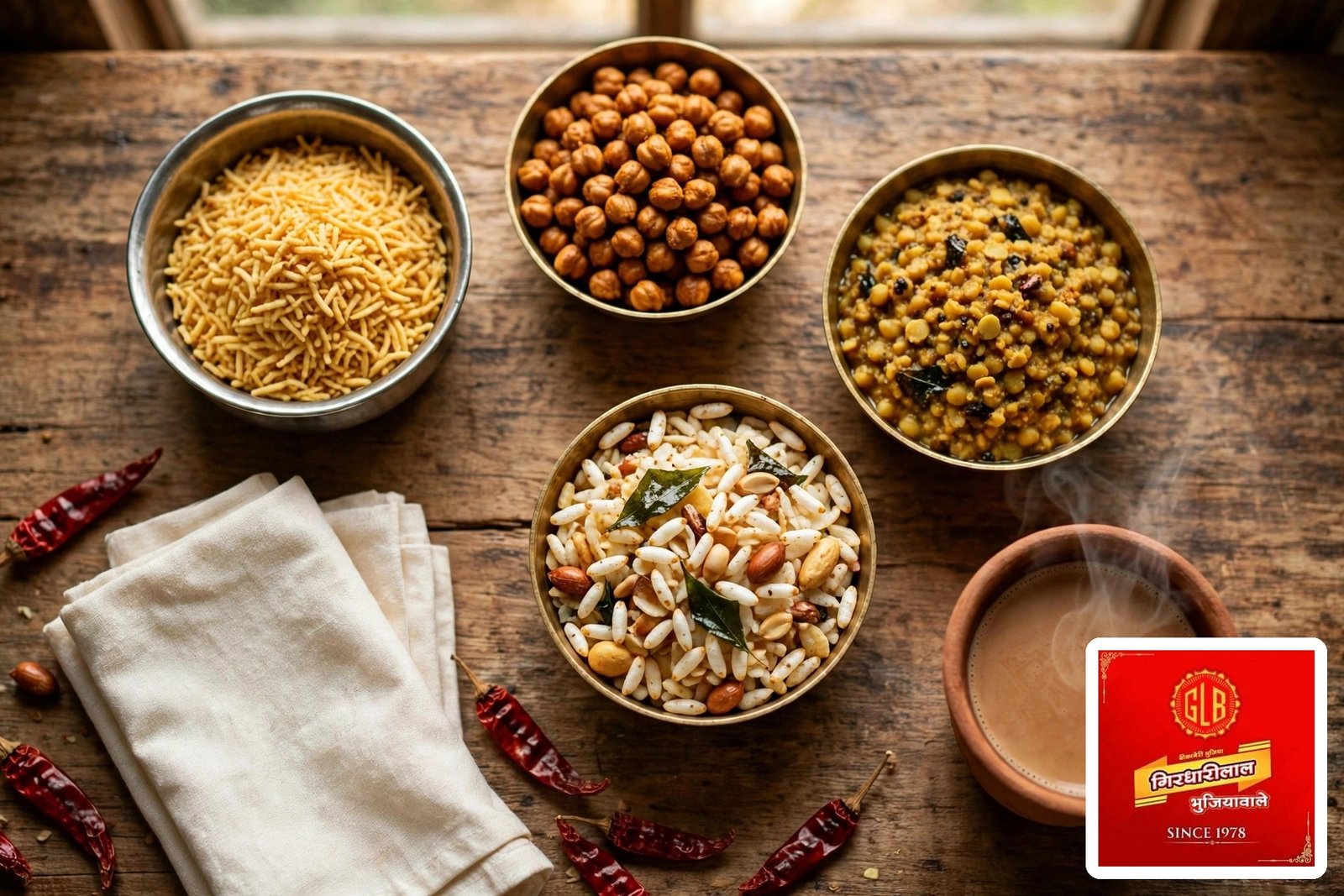
Bikaneri Bhujia for Weight Loss: How to Keep the Crunch Without Wrecking Your Calorie Budget
By Bite Basket · • 13 views
Let's get the awkward question out of the way first. Can you eat Bikaneri bhujia while you're trying to lose weight? Short answer: yes. But not the way most of us eat it.
Not by the fistful, straight from the packet, standing in the kitchen at 11 pm. Not as a second dinner. That version of bhujia will quietly undo a whole week of careful eating — and you won't even feel full afterwards. It's so light you can eat 200 grams before your stomach catches up.
I've done exactly that. More than once. So this isn't a lecture — it's the system I worked out after looking at the numbers properly.
The honest numbers first
Real Bikaneri bhujia has about 500 to 610 calories per 100 grams. A normal handful — 30 grams, roughly what fits in a cupped palm — is 150 to 180 calories. A small katori, loosely filled at 50 grams, is 250 to 300.
Half a 400g pack is 1,000 to 1,200 calories. That's more than half a day's food for a lot of people, eaten in the time it takes to watch one episode of something. So no, bhujia isn't a weight-loss food. But the number that matters isn't per 100 grams — it's per serving. And a serving is something you control.
Why bhujia isn't the worst snack in your kitchen
Here's the part that surprised me. For something this calorie-dense, bhujia has a better profile than most of its competition. Our calories guide has the full breakdown from pack labels and nutrition databases; here are the bits that matter for weight loss.
Protein. Real Bikaneri bhujia carries 12 to 16 grams of protein per 100 grams, because it's built on moth dal and besan, not refined flour. Potato chips give you 5 to 7 grams. That protein is why a small portion of bhujia actually satisfies you, while the same calories of chips leave you hunting for more.
Almost no sugar. Bhujia usually has under 1 gram of sugar per 100 grams. Biscuits, cookies, most packaged snacks — they can't say that. If you're cutting sugar, bhujia's already on your side.
Fibre. Around 5 to 7 grams per 100 grams in a moth-dal bhujia. Not a fibre food, exactly, but it slows you down and makes a small portion feel like more than it is.
None of this makes bhujia a health food. It's still fried. But it does mean the snack isn't empty calories — which is exactly why a ban never works, and why portion control does.
The 30-gram rule (and how to measure it without a scale)
Everything in this guide comes back to one number: 30 grams. That's your bhujia serving. One serving a day, with your evening chai, fits into almost any weight-loss plan. Three unmeasured handfuls scattered through the day usually doesn't.
You don't need a kitchen scale. Here's how 30 grams looks in real life:
- One cupped palmful. Not a heaped palm, not a fist. A relaxed cupped hand. That's about 30 grams.
- A small katori, half full. A loosely filled small katori is 50 grams, so half of that is your portion.
- A small steel bowl. If you always use the same bowl, you learn the level fast. Fill it to the same line every day and you stop guessing.
- Pre-portion from the pack. The moment a new pack arrives, divide it into small zip bags or dabbas of 30 grams each. This is the single most effective trick in this whole article. Eating from the bag is how 30 grams becomes 150.
When you eat it matters as much as how much
Same 30 grams, different results, depending on the moment you eat it.
With chai, after a real meal. This is the best slot. You've already eaten, so you're not ravenous. The bhujia is a flavour hit on top of a full stomach, and 30 grams is plenty.
As a topping, not the main event. Sprinkle 15 grams over poha, chaat or dahi. That's 75 to 90 calories, all crunch and flavour, and the meal underneath does the filling. Honestly, this is my favourite way to eat bhujia now.
Not late at night. Bhujia at 11 pm is never 30 grams. It's a packet, eaten standing up, half asleep. If the craving hits after dinner, make a cup of chai and have your measured bowl with it, sitting down. The ritual matters — it tells your brain the snack is finished.
The swaps: what to eat when you want crunch but not the calories
Some days 30 grams of bhujia isn't enough. You want a bigger bowl of something crunchy, and you want it to actually fill you. That's when you swap, not when you suffer.
Roasted chana. About 360 calories per 100 grams, with far more protein and fibre than bhujia. A 50-gram bowl is 180 calories and genuinely filling. Chandra Vilas Hing Chana is the Bikaner version — roasted chana with hing, the same savoury kick, a much kinder calorie count.
Diet chewda. Roasted, not fried, with dry fruits and mild spices. Chandra Vilas Diet Chewda Lite (500g, ₹115) is made for exactly this — low oil, everyday snacking, a proper bowl without the guilt maths.
Masala moong dal. Another dal-based crunch, lighter than bhujia and higher in protein per bite. Chandra Vilas Masala Moong Dal works as a straight swap on the days you want a bigger portion.
And the one to watch: aloo bhujia. Around 570 calories per 100 grams, more carbs, less protein than moth-dal bhujia. It's delicious, but it's the heaviest cousin in the family. If you're counting, treat it as a sometimes snack, not the daily one.
What a bhujia-friendly weight-loss day looks like
Theory's fine, but a real day helps. Here's how 30 grams of bhujia fits into a roughly 1,800-calorie day:
- Breakfast: poha with a 15-gram sprinkle of bhujia on top (75–90 calories of crunch).
- Lunch: normal dal, sabzi, roti. No bhujia here — save it.
- Evening chai, 5 pm: your 30-gram bowl of bhujia (150–180 calories), eaten sitting down, packet closed and put away.
- Dinner: light — khichdi or soup and salad. No snacking after.
Total bhujia for the day: 45 grams, about 230 calories. You've had it twice, enjoyed it both times, and stayed inside your budget. That's the whole trick. Bhujia doesn't need to leave your life. It needs a slot and a size.
One more thing, said plainly: if you have a medical condition — diabetes, blood pressure, a doctor-prescribed diet — check with your doctor or a dietitian first. Bhujia's sodium (650 to 1,000 mg per 100 grams) matters more than its calories for some people. This guide is general information, not medical advice.
Which bhujia to buy if you're watching your weight
If you're going to spend 150 calories on bhujia, spend them on the good stuff. A moth-dal bhujia from a heritage halwai gives you more protein and fibre per calorie than cheap besan sev — and it tastes like something, so a small portion satisfies.
Girdharilal Bikaneri Bhujia is the one I'd start with. Moth dal and besan, fried in groundnut oil, no palm oil — the higher-protein end of the range, from a house making bhujia since 1978. Here's the Girdharilal story. The oil in your bhujia changes the fat you're eating, and groundnut oil is the traditional Bikaner choice — our no-palm-oil guide explains why.
Bhikharam Chandmal Bikaneri Bhujia is the other heritage option — finer strands, a slightly different spice profile, same calorie ballpark. If Girdharilal's is your everyday bhujia, this is the one you keep for variety.
Hadman Ji (Sky King) Mahin Bhujia is fine-strand and feather-light, which is exactly why it's the easiest to overeat. If this is your favourite, pre-portioning isn't optional — it's the whole plan.
Whichever you pick, read the label on the pack when it arrives — heritage makers vary a little batch to batch. Our healthy-eating guide walks through the ingredients properly, and our homemade bhujia recipe shows how the moth-dal blend comes together.
The bottom line
Bikaneri bhujia and weight loss aren't enemies. They're just a bad match when bhujia is eaten by the packet, at midnight, standing in the kitchen. Give it a portion — 30 grams. Give it a slot — evening chai, or a sprinkle over a real meal. And on the days you want a bigger bowl, swap to roasted chana or diet chewda.
That's it. No ban, no guilt, no giving up the snack you grew up with. Just a small bowl, measured once, enjoyed properly.
Frequently asked questions
Can I eat Bikaneri bhujia during weight loss?
Yes, in a measured 30-gram portion (150–180 calories) once a day. It's calorie-dense, so the portion is everything — eating from the packet is where it goes wrong.
How many calories are in 30g of Bikaneri bhujia?
About 150–180 calories, with roughly 10g fat and 4–5g protein. That's the standard serving size on most pack labels.
Which namkeen is best for weight loss?
Roasted chana is the best of the Bikaner range — about 360 calories per 100 grams with high protein and fibre. Diet chewda and masala moong dal are good lighter options too.
Is Bikaneri bhujia better than chips for weight loss?
Per 100 grams they're similar in calories, but bhujia has roughly double the protein of potato chips and almost no sugar, so a small portion is more satisfying. Portion control decides both.
Can I eat bhujia every day while dieting?
A single 30-gram portion a day fits into most diets, as long as the rest of your day has room for it. Watch total calories and sodium — a daily 100-gram habit adds up fast on both.
Comments
Add a comment ↓No comments yet. Be the first to share your thoughts.
Leave a comment
Your email address will not be published. Comments appear after our team has read them.