
Best Bikaneri Bhujia Brand: 7 Things to Check Before You Buy Online
By Bite Basket · • 2 views
There is no single best Bikaneri bhujia brand, and any page that crowns one is selling you a ranking, not the truth. The best packet for you depends on what you like: mild or spicy, fine strands or thick crunch. What you can judge before buying is authenticity — moth dal on the ingredient list, Bikaner as the place of manufacture, a named Bikaner halwai house, and groundnut oil instead of palm oil.
Why "best" is the wrong question — and what to ask instead
Walk down the snack aisle of any Indian supermarket and you will see half a dozen packets calling themselves Bikaneri bhujia. Most of them were made hundreds of kilometres from Bikaner. That is the first thing to understand: "best Bikaneri bhujia brand" is really two questions hiding in one. First, which brands are genuinely Bikaneri? Then, of those, which one suits your taste?
The original is a desert snack with a long paper trail. The first batch of bhujia was made in Bikaner in 1877, during the reign of Maharaja Dungar Singh. It is built on moth dal (matki), a hardy desert legume, pressed through a fine press and fried — which is why it tastes nutty and peppery instead of bland. The name itself is legally protected: Bikaneri bhujia was granted Geographical Indication protection in October 2008, confirmed by the Indian Patent Office in September 2010. Only producers in the defined Bikaner territory, making it the traditional way, can use the name as a protected product name. Our GI tag explainer walks through what that means in plain language, and Wikipedia's Bikaneri bhujia article confirms the GI status.
So the honest way to shop is this: use a short checklist to separate the real Bikaneri brands from the "Bikaneri style" packets, then pick among the real ones by taste. Here is the checklist we use ourselves.
The 7 things the best Bikaneri bhujia brands have in common
1. Moth dal should lead the ingredient list
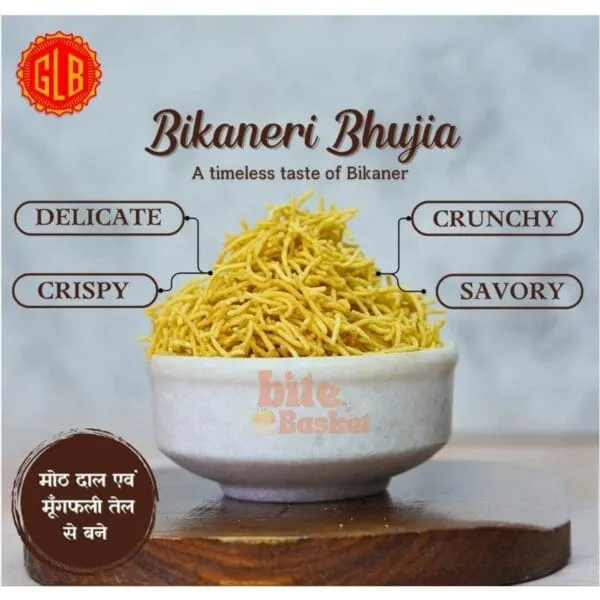
This is the single biggest tell. Real Bikaneri bhujia is a moth-dal snack first; gram flour (besan) plays a supporting role. If a packet's ingredient list is mostly besan with a long tail of additives, it is sev wearing a Bikaneri costume. Flip the packet and read before you buy. Moth bean is the desert legume behind that nutty flavour, and our guide to how bhujia is made shows how it goes from dal to press to packet.
2. Bikaner should be the place of manufacture
Check where the packet was actually made — not just where the brand is registered or marketed from. "Bikaneri style" is honest labelling for bhujia made elsewhere, and it is also a sign you are not buying the protected product. The GI tag exists precisely because factories far from Rajasthan were borrowing the city's name. A genuine packet names Bikaner as the place of manufacture.
3. The maker should be a Bikaner house you can trace
The most reliable packets name a family halwai house, not a faceless brand. Bikaner's bhujia tradition lives in houses that have been frying for generations — names with an address in the old city and a recipe older than the packet industry. On BiteBasket, four such houses cover the whole range of tastes: Girdharilal (since 1978), Bishanlal Babulal (since 1956), Bhikharam Chandmal (100+ years) and Sky King Hadman Ji. More on each below.
4. Groundnut oil, no palm oil
Bikaner's halwais traditionally fry in groundnut oil, and it matters to the taste — the bhujia comes out drier and cleaner, without the heavy after-feel of cheaper oils. Palm oil is the industrial shortcut, and you can taste the difference. Every bhujia stocked on BiteBasket is made without palm oil, across all four houses. Here is why Bikaner's halwais still fry in groundnut oil.
5. Pick the texture and spice level for your taste
This is where "best" becomes personal. Bikaneri bhujia is not one texture: there is mahin (fine strands), mota (thick, extra-crunchy), 3-number, lehsun (garlic) for a punchier evening snack, and mild no-chilli versions for kids or low-spice eaters. If you are buying for the first time, start with a classic fine-strand bhujia — it is the most representative taste of the city — then branch out once you know what your family reaches for.
6. Look for the FSSAI license number on the pack
Every packaged food sold in India is required to carry an FSSAI license number on its label. It is a quick trust signal: a packet that hides it, or carries a blurry photocopied-looking label, deserves a second thought. FSSAI is the authority behind India's food safety standards, and checking the license number takes ten seconds.
7. Check what the price is actually buying
Two packets can look identical on the shelf and differ for honest reasons: the maker's range, the pack size, whether it is an everyday bhujia or a special small-batch one like hand-pressed paraat bhujia. Compare price per 100 grams rather than packet to packet. Price alone never tells you which brand is best — but it should make sense once you know what is inside the pack.
The four Bikaner houses on BiteBasket
Once a brand passes the checklist, the choice is taste. These are the four halwai houses BiteBasket curates, and how they differ:
| House | Since | Signature | Best for |
|---|---|---|---|
| Girdharilal Bhujiawale | 1978 | Classic peppery everyday bhujia; widest range (classic, lehsun, aalu, mota, 3-no) | First-time buyers; daily snacking and chaat |
| Bishanlal Babulal | 1956 | Paraat bhujia — dough hand-pressed through a brass press in small batches | Guests and gifting; the connoisseur's pick |
| Bhikharam Chandmal | 100+ years | Fine-strand classic bhujia; also one of Bikaner's great sweet makers | Festive hampers needing bhujia plus sweets |
| Sky King Hadman Ji | — | Mahin (fine) bhujia; mild no-chilli options | Delicate crunch lovers; low-spice family snacking |
A few notes from tasting them side by side. Girdharilal is the safest first packet: peppery, balanced, fine-to-medium strands, and the house's range means you can explore lehsun or aalu bhujia once you know you like the base. Bishanlal Babulal's paraat bhujia is the one to serve when guests come over — slightly irregular hand-pressed strands, a deeper roasted flavour, and a story worth telling at the table. Bhikharam Chandmal is the all-rounder: consistently crisp fine strands, and because the house also makes sweets, one order can cover both halves of a festive box. Sky King Hadman Ji's mahin bhujia is the delicate one — and its no-chilli version is the packet to reach for when kids or spice-sensitive eaters are at the table.
No single house "wins". That is the point the checklist leads to: buy the real thing first, then buy the one that matches your mouth.
Taste it for yourself
The cheapest way to settle the "best brand" argument in your own house is a tasting, not a ranking. Order one pack of each and compare them side by side — sealed packs stay crisp for weeks, so there is no rush. Start with Girdharilal's classic Bikaneri bhujia for the benchmark taste of the city, and add Sky King Hadman Ji's mild mahin bhujia if your table includes low-spice eaters. Every pack ships pan-India from Bikaner.
Frequently asked questions
Which is the best Bikaneri bhujia brand?
There is no single winner. Girdharilal is the best everyday classic, Bishanlal Babulal's paraat bhujia is the best special-occasion pick, Bhikharam Chandmal is the best all-rounder for festive hampers, and Sky King Hadman Ji is the best mild, delicate option. All four are authentic GI-tradition Bikaneri bhujia made from moth dal.
Is factory-made "Bikaneri style" bhujia the same thing?
Usually not. Mass-market "Bikaneri style" bhujia is typically besan-based sev made anywhere in India, fried at industrial scale. Real Bikaneri bhujia is moth-dal based, made in Bikaner by the traditional method that earned the GI tag. The ingredient list and the place of manufacture tell you which one you are holding.
How can I tell if a packet is genuinely from Bikaner?
Check four things on the pack: moth dal high on the ingredient list, Bikaner named as the place of manufacture, a named Bikaner maker rather than a generic brand, and an FSSAI license number. Groundnut oil instead of palm oil is a fifth good sign.
Does the GI tag mean every Bikaneri bhujia tastes the same?
No. The tag protects origin and traditional character, not a single flavour. Different Bikaner houses season their bhujia differently — that variety is part of the tradition.
Which bhujia should a first-time buyer try?
Start with a classic fine-strand bhujia like Girdharilal's — it is the most representative taste of Bikaner. If you eat mild, pick a no-chilli mahin bhujia such as Sky King Hadman Ji's instead.
Buy the real thing first, then buy the one your family reaches for without thinking. In Bikaner, that second part is the only ranking that has ever mattered.