
Best Bhujia in Jaipur: Where to Find Authentic Bikaneri Bhujia (2026 Guide)
By Bite Basket · • 7 views
Why Jaipur keeps asking for Bikaneri bhujia
Ask anyone in Jaipur where the good bhujia comes from and you'll get the same answer, usually with a little eye-roll at the question itself: Bikaner, of course. It's a three-hundred-odd kilometre drive north-west, but in snack terms the two cities might as well be next door. Jaipur's markets are full of bhujia — every kirana shelf, every namkeen counter in Johari Bazaar and Badi Chaupar has a dozen packets — yet the packets that get finished first, the ones people ask for by name when a relative visits from Bikaner, are almost always the Bikaneri ones.
There's a reason for that, and it's not nostalgia alone. Real Bikaneri bhujia is made from moth dal, not besan, and it's fried in groundnut oil, not palm oil. That combination — the nutty edge of moth dal, the clean fry, the coarse hand-pressed texture — is what the big factory brands have spent decades trying to imitate. Some come close. Most don't. And in Jaipur, where people genuinely know their snacks, the difference gets noticed fast.
What "the best bhujia in Jaipur" actually means
Let's be honest about what people mean when they search this. Almost nobody is looking for a Jaipur-made bhujia. They're looking for Bikaneri bhujia they can get in Jaipur — for the house, for guests, for gifting, for the monthly stock-up. The search is local; the craving is Bikaneri.
That matters because it changes how you should judge a packet. A bhujia made in Jaipur can be perfectly good namkeen. But if it says "Bikaneri" on the pack, it should taste like Bikaner: moth dal forward, properly spiced, fried crisp. The test is simple. Open a pack and ask yourself three things. Does it smell like roasted dal and black pepper, or like oil? Does it snap, or does it bend? And does the flavour build as you chew, or flatten out after the first bite? The real stuff passes all three.
The Jaipur problem: too many packets, not enough Bikaner
Jaipur's namkeen counters have a specific problem, and it's one the shopkeepers won't tell you about. The same shelf holds factory bhujia from national brands, local Jaipur-made sev, and a handful of genuinely Bikaneri packets — all at wildly different prices, all claiming the same heritage. The national brands are consistent and easy to find, but they're made for a national palate: milder, smoother, and fried in cheaper oil. The local sev is often fresh and cheap, but it's besan sev wearing a Bikaneri label.
The genuinely Bikaneri packets are the ones that disappear fastest, which is exactly why they're also the hardest to find reliably. Small halwais in Bikaner don't produce at factory scale. Their batches are limited, their distribution is thin, and when a batch sells out in Jaipur, the shelf gets filled with whatever's available. That gap — between what Jaipur wants and what reaches Jaipur — is the whole reason buying direct from Bikaner has become the sensible option.
What to look for before you buy
Whether you buy from a shop in Jaipur or order online, the checklist is the same.
- Moth dal, not besan. Check the ingredients. Real Bikaneri bhujia lists moth dal (moth bean flour) first. If besan is the first ingredient, you're holding sev, not bhujia.
- Groundnut oil, not palm oil. The old Bikaner halwais fry in groundnut oil. Palm oil is cheaper, but it leaves that heavy, waxy aftertaste. The Girdharilal range on BiteBasket carries a No Palm Oil tag on every product, which is exactly the kind of detail worth checking for.
- Small-batch and freshly packed. Look for a recent packing date. Bhujia's enemy is time and air, and a packet packed three months ago will taste like it, no matter how good the recipe was.
- A real maker, not a generic brand. The best bhujia in Bikaner comes from named halwais with decades behind them — families, not factories. If the pack names a maker you can look up, that's a good sign. If it's a generic label, be sceptical.
- Price that makes sense. If a packet is suspiciously cheap, something was cut — usually the oil or the dal. Our 2026 Bikaneri bhujia price guide breaks down what fair prices look like across brands, so you can spot a bargain from a compromise.
The Bikaner halwais Jaipur buyers should know
Three names come up again and again when Jaipur families talk about bhujia, and they're worth knowing because each one tastes different. This isn't a ranking — our honest 8-brand ranking of Bikaneri bhujia does the full comparison — but if you're ordering for the first time, this is where I'd start.
Bishanlal Babulal — the Jaipur favourite
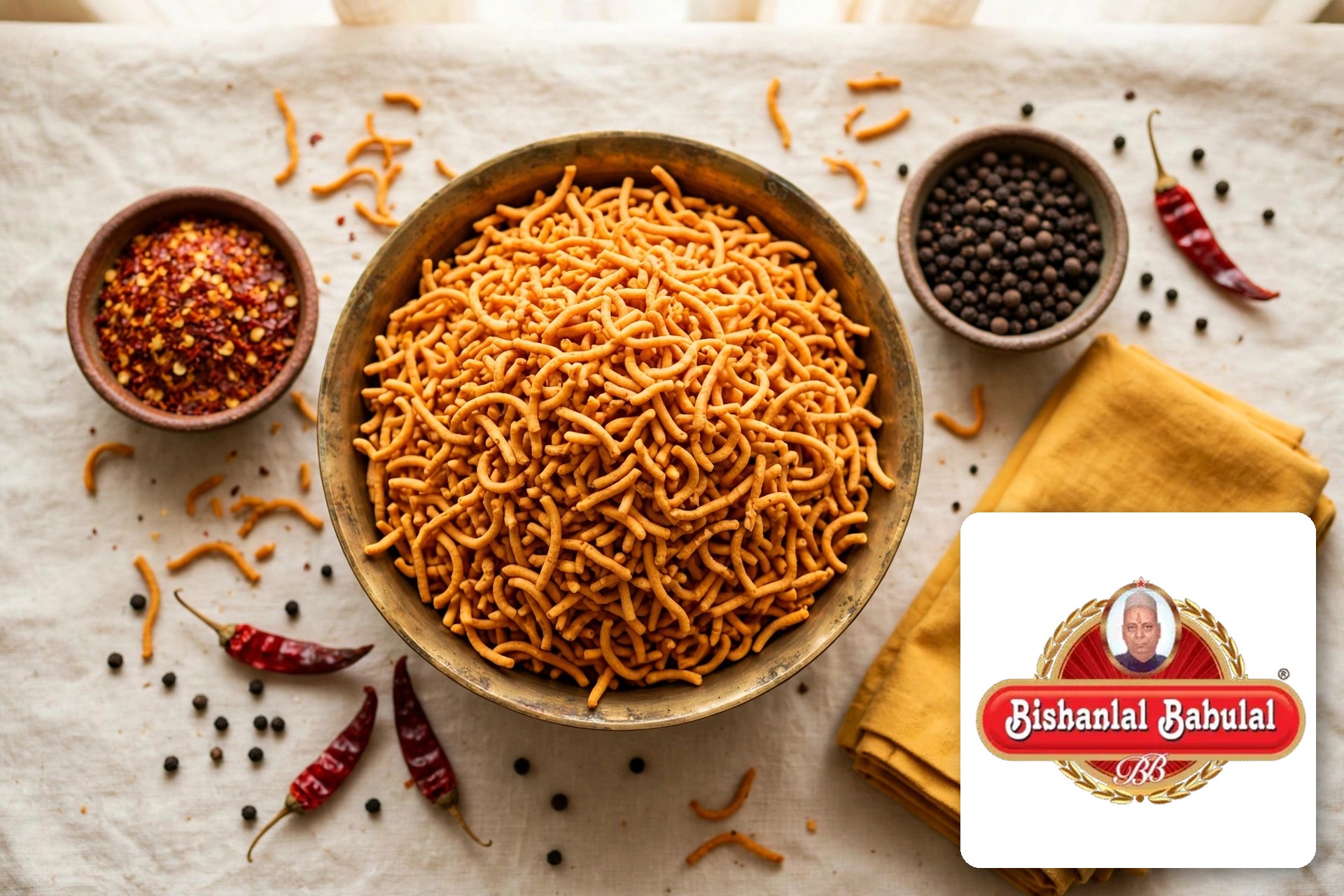
If there's one Bikaner halwai whose name travels to Jaipur most often, it's Bishanlal Babulal, frying since 1956. Their bhujia is the one Jaipur households ask for by name — coarse, properly spiced, with that old-school moth dal bite factory packets can't copy. Read the full story in our Bishanlal Babulal profile. For a first order, their classic Bishanlal Babulal Bikaneri Bhujia is the safest bet.
Girdharilal — the no-palm-oil purist
Girdharilal has been frying since 1978, and they're the ones to pick if the oil matters to you — and it should. Every product in their range is fried in groundnut oil, no palm oil, no shortcuts. Their lehsun bhujia and mota bhujia are the two I'd point a first-timer at: bold, crunchy, and unmistakably handmade. Browse the full namkeen range to see what else they make.
Bhikharam Chandmal — the old house
Bhikharam Chandmal is the heritage name, and their bhujia leans classic — the flavour your grandparents would recognise. They're also the ones to remember at festival time, because the same house makes the sweets Jaipur orders alongside the bhujia: rasgulla, soan papdi, and the rest. If your order is a mixed box of namkeen and mithai, start here with their Bikaneri Bhujia.
How Jaipur buyers actually order from Bikaner
There are three ways to get Bikaneri bhujia in Jaipur, and they aren't equal. The local shop is fine for a single packet when you need it today — you pay the Jaipur markup and take whatever batch is on the shelf. Asking someone travelling to Bikaner is how most Jaipur families did it for years, but it depends on someone's travel plans. Ordering direct from Bikaner online is what I'd recommend to anyone who eats bhujia weekly: you pick the maker, pick the packs, and the order ships from Bikaner to your Jaipur address. Our guide to buying Bikaneri bhujia online walks through the whole thing — what to check, what to avoid, and why buying from the maker beats the marketplace. The short version: no middleman markup, the maker's own packing date, and delivery across India in a couple of days.
If you're ordering for the first time, I'd suggest a small mixed order: one classic bhujia, one flavoured one (lehsun or pudina), and one pack of papad or mixture to round it out. That way you find your household's favourite before committing to the big family pack.
Storing bhujia in Jaipur's heat
Jaipur summers are unkind to namkeen. Once you open a pack, move what's left into an airtight steel dabba or a clip-lock jar, keep it away from the stove and the sun, and don't leave the pack open between servings. Unopened packs keep well on a cool, dry shelf, but don't stockpile for six months in summer — order the quantity you'll finish in a month, and order again. Freshness is the whole point of ordering from the maker; hoarding defeats it.
What to pair it with
Jaipur has strong opinions about what goes with bhujia. A cup of masala chai is the default. But the combinations worth trying: bhujia with dahi and chopped onion as an evening chaat, bhujia crushed over poha or upma for crunch, and — the Jaipur household classic — bhujia with a simple dal-chawal lunch, where it does the job papad usually does, only better.
Frequently asked questions
Where can I buy authentic Bikaneri bhujia in Jaipur?
You can find Bikaneri bhujia at namkeen counters across Jaipur, but for guaranteed authenticity, order direct from Bikaner makers like Bishanlal Babulal, Girdharilal or Bhikharam Chandmal. BiteBasket ships their bhujia from Bikaner to Jaipur and across India, so you get the maker's own fresh batch rather than whatever the local shelf has this week.
How much does Bikaneri bhujia cost in Jaipur?
Prices vary by maker and pack size, but expect roughly Rs 150–350 for a 400g–1kg pack from a heritage halwai. Local shops in Jaipur usually charge a markup over the Bikaner price, so ordering direct from the maker is generally the cheapest way to get the genuine article.
Does BiteBasket deliver bhujia to Jaipur?
Yes — BiteBasket ships pan-India, including Jaipur, directly from Bikaner. Orders typically arrive within a few days, packed by the maker, so the bhujia reaches you fresh rather than sitting in a warehouse.
Is Bikaneri bhujia different from the sev sold in Jaipur?
Yes. Real Bikaneri bhujia is made from moth dal and has a GI tag protecting its origin, while most sev sold locally is made from besan (gram flour). Moth dal gives bhujia its distinctive nutty flavour and coarse, crisp texture. If besan is the first ingredient on the pack, it's sev, not Bikaneri bhujia.
Comments
Add a comment ↓No comments yet. Be the first to share your thoughts.
Leave a comment
Your email address will not be published. Comments appear after our team has read them.