
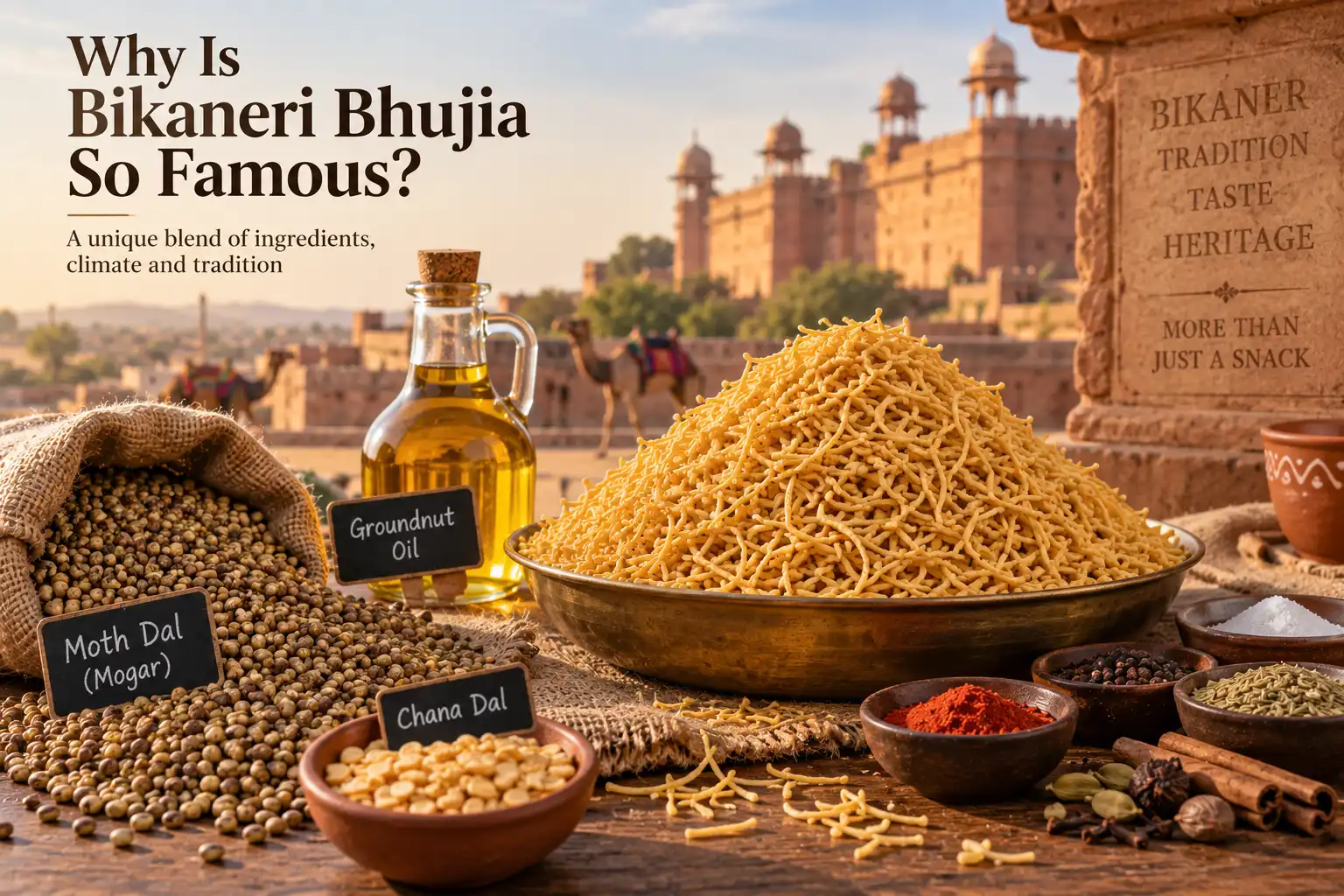
Why Is Bikaneri Bhujia So Famous? The Real Story Behind Bikaner’s Favourite Snack
Published on • 2 views
There are plenty of sev and namkeen varieties in India, but mention Bikaneri Bhujia and most people immediately know what you mean. It has a very particular crunch, a delicate texture and a flavour that is difficult to confuse with ordinary sev.
So, why is Bikaneri Bhujia so famous?
The answer is not one secret ingredient. It is the combination of moth dal, the dry conditions of Bikaner, traditional spices, local water, careful preparation and the way the bhujia is fried. Bikaner's geography has played a surprisingly important role in the story of this famous snack.
1. Moth Dal Is at the Heart of Bikaneri Bhujia
One of the biggest differences between traditional Bikaneri Bhujia and ordinary sev is the use of moth dal, also known as moth gram or mogar dal.
Moth is a hardy pulse that grows particularly well in the dry, sandy conditions of Rajasthan. It does not need the kind of water-rich environment required by many other crops, which made it naturally suited to the region around Bikaner.
The official geographical indication material for Bikaneri Bhujia identifies moth gram as one of the important reasons behind the snack's distinctive character. The traditional formula uses moth along with chana dal, oil, salt and spices.
That is one reason authentic Bikaneri Bhujia isn't simply another name for sev. The base ingredient matters.
2. Bikaner's Climate Is Part of the Story
Bikaner sits in the Thar Desert region of Rajasthan. The climate is dry, hot and has very little rainfall compared with many parts of India.
At first, this may not sound like something that could affect a namkeen. But it does have a connection with Bikaneri Bhujia.
The dry environment is particularly suitable for growing moth, the pulse traditionally associated with Bikaneri Bhujia. Bikaner's sandy soil and arid conditions helped make moth cultivation a natural part of the local food system.
The official GI documentation describes Bikaner's climate as arid to extremely arid, with sandy soils, erratic rainfall and high evaporation. It also specifically connects the region's climatic conditions with the distinctive qualities of Bikaneri Bhujia.
So when we say that Bikaneri Bhujia tastes different because it comes from Bikaner, there is actually some geography behind that statement.
3. Even the Local Water Has Been Part of the Traditional Formula
This is probably one of the lesser-known parts of the Bikaneri Bhujia story.
Traditional GI documentation notes that groundwater in the Bikaner region is relatively hard and saline, with a higher chloride content. The documentation connects these characteristics of the local water with the crispness, taste and flavour of the traditional product.
Of course, modern commercial production does not mean that every packet of Bhujia is made using untreated local groundwater. Production methods have changed considerably over the years.
But historically, the ingredients, water and environment available in Bikaner all became part of what made the local style of Bhujia distinctive.
4. Groundnut Oil Adds Its Own Character
Oil might sound like a small detail, but anyone who has tasted freshly made namkeen knows that the frying oil can make a noticeable difference.
Groundnut oil, also called peanut oil, has traditionally been used in some Bikaneri Bhujia preparations. It has a relatively neutral but slightly nutty character and works well for frying namkeen at the high temperatures needed to develop that familiar crisp texture.
However, recipes and manufacturers differ, so it would be inaccurate to say that every Bikaneri Bhujia is fried only in groundnut oil. The traditional GI formula simply identifies oil as one of the key ingredients.
What matters is the balance between the moth-based dough, spices, oil and frying technique. Get that balance right and the result is a Bhujia that is light, crisp and full of flavour.
5. The Spice Mix Is Simple but Distinctive
Bikaneri Bhujia isn't supposed to taste like a heavily seasoned masala snack.
The traditional style uses a relatively straightforward combination of spices and seasonings. Depending on the recipe, these can include red chilli, black pepper, ginger, cardamom, cloves, nutmeg, cinnamon and other traditional spices.
The interesting part is how these spices work with the flavour of moth dal.
There is heat, but there is also aroma. There is salt, but the flavour doesn't stop there. A good Bikaneri Bhujia has enough seasoning to make you reach for another handful without completely covering the flavour of the base ingredient.
6. That Fine, Delicate Texture Makes a Difference
Look closely at Bikaneri Bhujia and you will notice that the strands are usually very fine.
The dough is traditionally passed through a perforated tool known locally as a jharra, creating the thin strands that are then fried.
That fine structure gives Bikaneri Bhujia its characteristic texture. When it is fried properly, the strands become crisp without turning into a thick, hard snack.
It is this combination of a fine strand, light crunch and strong seasoning that makes Bikaneri Bhujia so easy to eat by the handful.
7. Bikaneri Bhujia Has Been Part of Bikaner's Food Culture for Generations
Bikaneri Bhujia is not a snack that became popular overnight.
Historical accounts trace the beginnings of Bhujia production in Bikaner to the late 19th century, during the reign of Maharaja Dungar Singh. What started as a local speciality gradually became an important part of Bikaner's food and small-scale manufacturing culture.
Over generations, Bhujia makers in Bikaner refined their own methods, spice combinations and production techniques. The snack eventually travelled far beyond Rajasthan.
Today, you can find Bhujia in shops across India, but the name Bikaneri Bhujia remains closely associated with its place of origin.
8. Bikaneri Bhujia Is More Than Just a Snack
Ask someone from Rajasthan what they would take home from Bikaner and Bhujia is very likely to come up.
It works with tea, can be served with meals, added to chaats and used to give other snacks an extra crunch. It is also one of those foods that travels well, which helped it move from a regional speciality to a snack enjoyed throughout India.
That combination of long-standing tradition, distinctive ingredients and easy everyday use is a big part of its popularity.
So, Why Is Bikaneri Bhujia So Famous?
The simplest answer is that Bikaneri Bhujia brings together things that are difficult to separate from its place of origin.
- Moth dal gives the traditional Bhujia its distinctive base.
- Bikaner's dry, sandy environment is naturally suited to moth cultivation.
- Traditional spices give it its familiar savoury and mildly spicy character.
- Traditional frying methods create the fine, crisp strands.
- Groundnut oil, where used, contributes to the flavour and frying character.
- Bikaner's local water and geography have historically been associated with the product's distinctive qualities.
- And decades of local knowledge turned a regional snack into one of India's best-known namkeen varieties.
That is what makes Bikaneri Bhujia special. It isn't just a recipe that can be copied by changing a few ingredients. The story of the snack is tied closely to Bikaner's land, climate, crops and food traditions.
Where Can You Buy Bikaneri Bhujia Online?
If you want to try authentic Bikaneri Bhujia from Bikaner, you can explore the Girdharilal Bikaneri Bhujia available on BiteBasket.
You can also explore the wider collection of Bikaneri Namkeen to try different traditional snacks from Bikaner.
Frequently Asked Questions
Why is Bikaneri Bhujia different from regular Bhujia?
The traditional Bikaneri style is strongly associated with moth dal, a particular spice profile and the traditional methods developed in Bikaner. “Bhujia” is now used more broadly for many similar snacks, while Bikaneri Bhujia refers to the traditional Bikaner product.
Is moth dal used in Bikaneri Bhujia?
Yes. Moth gram is one of the defining traditional ingredients of Bikaneri Bhujia and is particularly well suited to the arid conditions of Rajasthan.
Is Bikaneri Bhujia made with peanut oil?
Groundnut or peanut oil is used in some traditional preparations, although oil types can vary between manufacturers. Always check the ingredient list of the particular product you are buying.
Why is Bikaneri Bhujia so crispy?
The crisp texture comes from several factors working together, including the moth-based dough, fine strands, frying temperature and production method. Traditional GI documentation also notes the role of Bikaner's local water characteristics.
Is Bikaneri Bhujia a GI product?
Yes. Bikaneri Bhujia is a registered Geographical Indication product in India. The official IP India record lists Bikaneri Bhujia under Application No. 142 in Class 30.