
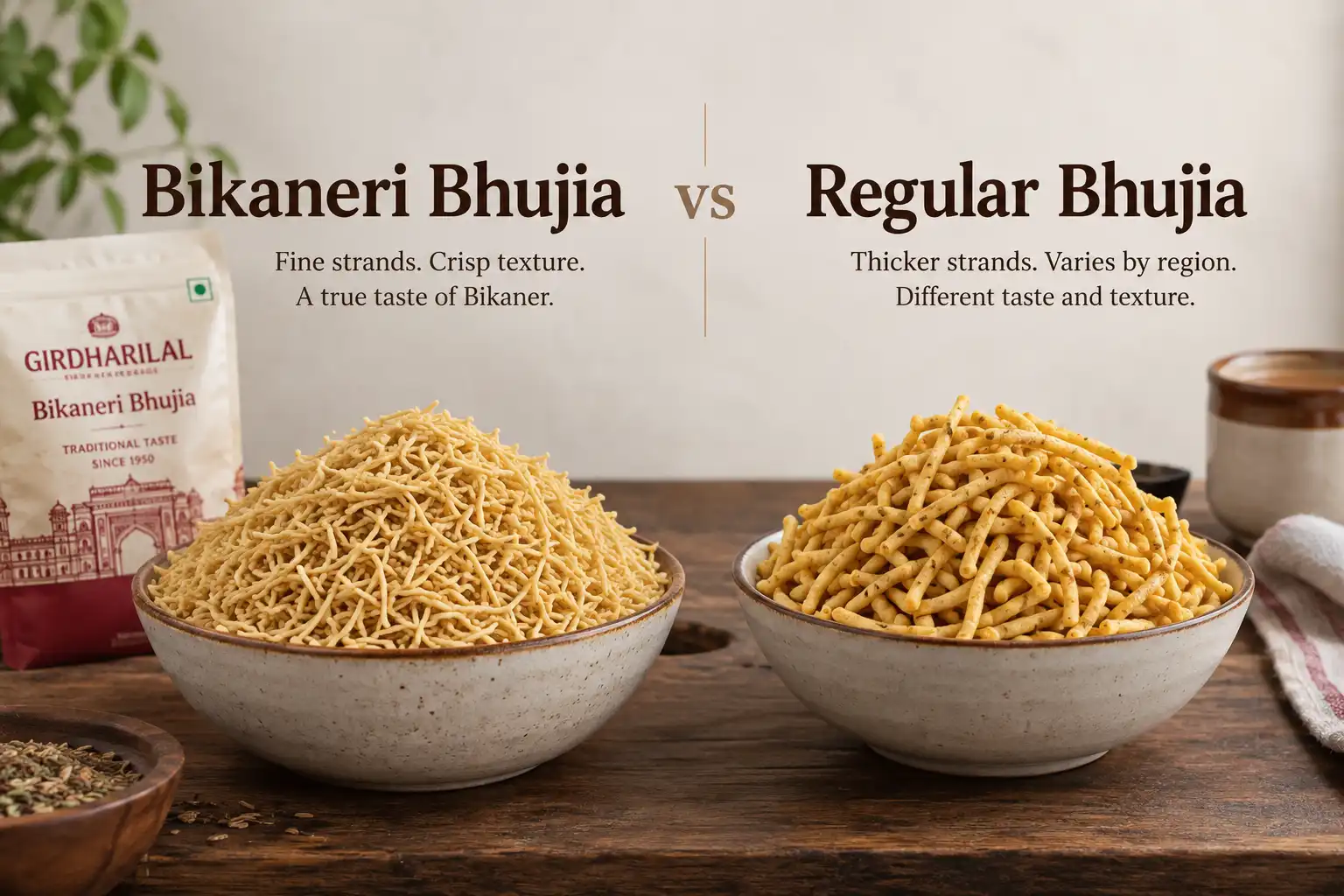
Bikaneri Bhujia vs Regular Bhujia: What Is the Difference?
Published on • 3 views
Pick up a packet of bhujia from almost anywhere in India and you will probably notice one thing: it looks familiar. Thin, crispy strands, a savoury taste and plenty of crunch. But put that next to a traditional Bikaneri Bhujia, and the difference can be easier to notice than you might expect.
So, what exactly is the difference between Bikaneri Bhujia and regular bhujia? The short answer is that “bhujia” is a broad name for a type of savoury snack, while Bikaneri Bhujia refers to a style closely associated with Bikaner and its traditional food culture.
The recipe can also vary from one manufacturer to another, so there is no single recipe that defines every packet sold as bhujia. Still, there are some characteristics that help explain why Bikaneri Bhujia has become so closely associated with Bikaner.
What Is Bikaneri Bhujia?
Bikaneri Bhujia is a thin, crunchy namkeen traditionally associated with Bikaner, Rajasthan. It is generally made using ingredients such as gram flour and spices, although the exact ingredients and proportions depend on the recipe and manufacturer.
One of the things people notice first is the texture. Good bhujia should have a light, crisp bite rather than feeling heavy or excessively oily. The fine strands also give it a very different eating experience from thicker namkeen varieties.
Bikaneri Bhujia has become one of the foods most strongly associated with Bikaner's culinary identity. If you want to try a traditional-style version, you can explore Bikaneri Bhujia at BiteBasket .
What Do People Mean by “Regular Bhujia”?
This is where the comparison can get slightly confusing.
“Regular bhujia” is not necessarily one specific recipe. The word is often used more generally for thin savoury noodle-like namkeen. Different brands and regions may use different combinations of flour, pulses, spices and seasonings.
Some versions may be very fine, while others are thicker. Some may have a stronger chilli flavour, while others are milder. The colour and texture can also change depending on the ingredients and preparation method.
So when comparing Bikaneri Bhujia vs bhujia, it is useful to remember that Bikaneri Bhujia is a particular regional style, whereas “bhujia” can be used as a broader description.
Bikaneri Bhujia vs Regular Bhujia: Key Differences
| Feature | Bikaneri Bhujia | Regular Bhujia |
|---|---|---|
| Regional association | Strongly associated with Bikaner, Rajasthan | Can refer to bhujia made in different regions |
| Texture | Usually fine and crisp | Can range from fine to relatively coarse |
| Flavour | Typically savoury with a distinctive spice profile | Depends on the recipe and manufacturer |
| Ingredients | Often based around gram flour and traditional spices | Ingredients vary between products |
| Food identity | Closely connected with Bikaner's food culture | More general namkeen category |
Is Bikaneri Bhujia Spicier Than Regular Bhujia?
Not necessarily.
Spice levels depend on the particular recipe. One Bikaneri Bhujia may be noticeably spicier than another, while a different regular bhujia could be just as spicy or even more so.
What usually matters more is the overall combination of seasoning, texture and the ingredients used. If you prefer a stronger chilli flavour, check the product description and ingredients before ordering.
Why Does Bikaneri Bhujia Have Such Fine Strands?
The fine strands are one of the most recognisable characteristics of Bikaneri-style bhujia. The dough or mixture is passed through a fine perforated mould before being fried, producing the familiar thin strands.
That fine texture is part of what makes bhujia so easy to sprinkle over other foods. It works just as well in a small bowl with evening tea as it does over chaat, poha or other savoury dishes.
What Does Bikaneri Bhujia Taste Like?
There isn't one single flavour profile that applies to every Bikaneri Bhujia, but it is generally savoury, crunchy and seasoned with spices.
The interesting part is how much the texture contributes to the experience. A handful starts with a crisp bite, followed by the seasoning. That's one reason bhujia works so well as a snack on its own.
It is also easy to pair with other foods. A little bhujia over a bowl of poha or a chaat can add another layer of crunch without requiring much preparation.
Why Is Bikaneri Bhujia Associated With Bikaner?
Food and place are often closely connected in Rajasthan. Bikaneri Bhujia is one of the clearest examples of this.
Bikaner is widely known for its traditional snacks, and bhujia has become an important part of the city's food identity. Rajasthan Tourism also highlights bhujia among the products associated with shopping in Bikaner.
Over time, the name “Bikaneri Bhujia” has therefore come to mean more than simply a crispy namkeen. For many people, it represents a particular style of snack associated with the city.
How to Choose Bikaneri Bhujia Online
If you're buying Bikaneri Bhujia online, don't choose only by the product name. Take a moment to look at the manufacturer, ingredients, pack size, storage instructions and product details.
The exact taste can differ considerably between manufacturers, even when two products are both described as Bikaneri Bhujia.
At BiteBasket, you can view the Girdharilal Bikaneri Bhujia product page and check the available product information before ordering.
How to Enjoy Bikaneri Bhujia
Honestly, there isn't much preparation involved. That's part of its appeal.
You can simply open the packet and serve it as a snack with tea. It can also be added to poha, upma, chaat, sandwiches and other savoury dishes when you want some extra crunch.
Another simple option is to combine different namkeen varieties on a serving plate when guests come over. Bikaneri Bhujia works particularly well as the lighter, crispy element in the mix.
If you enjoy exploring different varieties of Indian namkeen, you can also browse BiteBasket's Namkeen collection .
So, Which One Should You Try?
The difference between Bikaneri Bhujia and regular bhujia isn't simply a matter of one being better than the other. “Bhujia” covers a wider range of products, and recipes vary between brands.
Bikaneri Bhujia is distinguished mainly by its connection with Bikaner's traditional food culture, its characteristic fine strands and the particular combination of ingredients and spices used by individual makers.
If you're curious about the Bikaneri style, starting with a traditional Bikaneri Bhujia is a good way to understand what makes the snack associated with Bikaner so recognisable.
Explore Bikaneri Bhujia at BiteBasket
Frequently Asked Questions
Is Bikaneri Bhujia different from normal bhujia?
Bikaneri Bhujia refers to a style of bhujia associated with Bikaner, Rajasthan. “Bhujia” is a broader term and can refer to products made using different recipes and ingredients.
What is the main ingredient in Bikaneri Bhujia?
Many Bikaneri Bhujia recipes use gram flour along with spices and other ingredients. The exact recipe varies between manufacturers, so the product label is the best source for the specific ingredients in a particular packet.
Is Bikaneri Bhujia spicy?
It can be. The level of spice depends on the particular recipe and manufacturer. Some varieties have a stronger chilli and spice profile, while others are milder.
Where can I buy Bikaneri Bhujia online?
You can buy Bikaneri Bhujia online from BiteBasket and explore other traditional Bikaneri and Rajasthani snacks in the Namkeen collection .
What makes Bikaneri Bhujia famous?
Its association with Bikaner, fine crispy strands and distinctive savoury seasoning have made Bikaneri Bhujia one of the best-known snacks associated with the city.